Smoldering multiple myeloma (SMM) is a premalignant plasma cell disorder affecting approximately 1 in 200 individuals of northern European ancestry and occurring at even higher prevalence among individuals of African ancestry. SMM progresses at variable rates to symptomatic multiple myeloma (MM), a malignancy associated with anemia, bone destruction, and renal failure. Although patients with high-risk SMM (>20% annual risk of progression) are increasingly enrolled in interventional clinical trials using therapies approved for MM, the majority of patients with low- to intermediate-risk SMM (2-10% annual risk) have no recommended interventions and limited access to clinical trials. There is a critical need for reliable, pre-clinical models of of this disease stage, to study the mechanisms of progression and the effects of low-risk, well tolerated interventions. Our central hypothesis is that an inflammatory bone marrow microenvironment contributes to MM progression and can be modulated by anti-inflammatory therapeutic strategies.
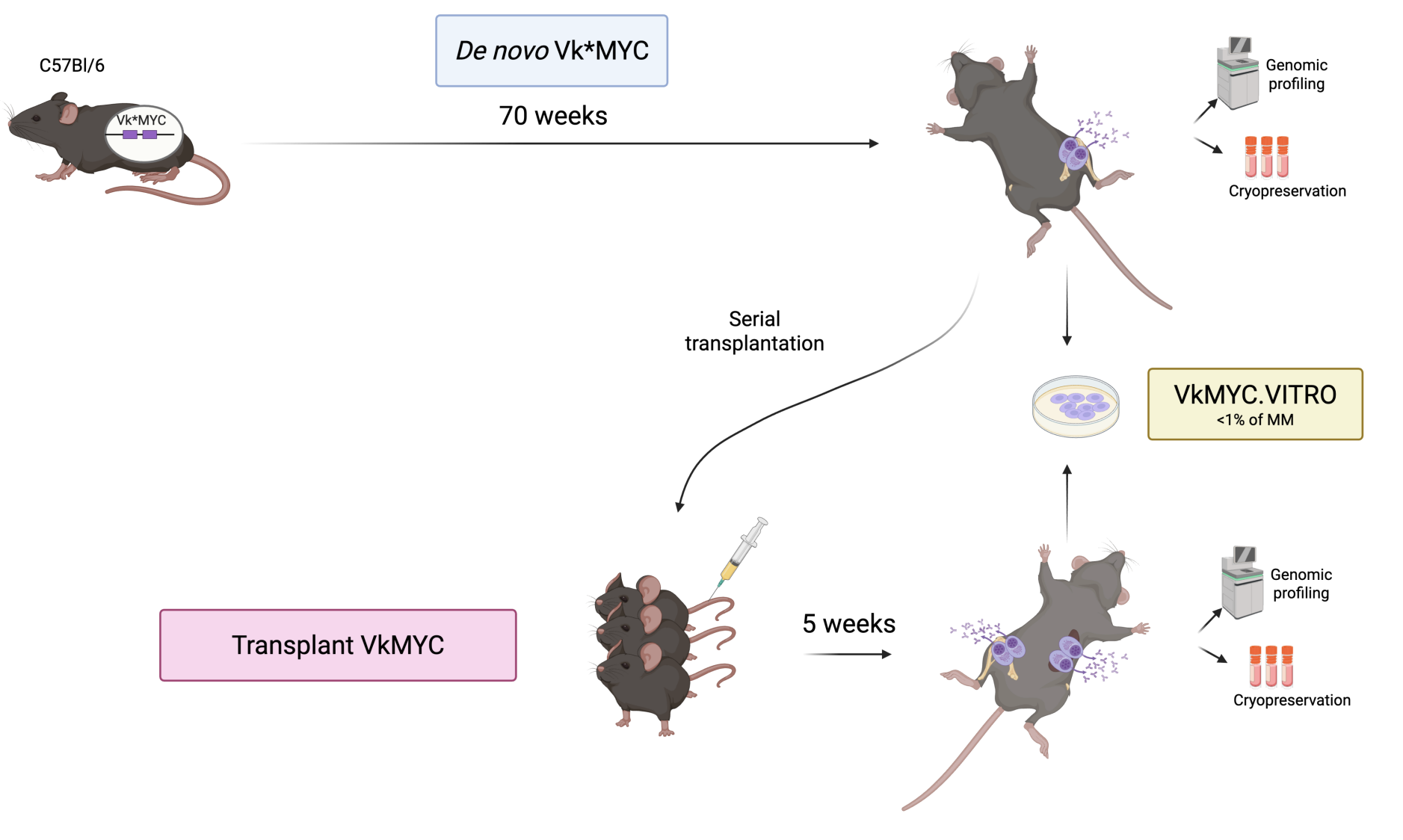
The development of safe, low-risk immunoprevention strategies for this large patient population requires faithful, orthotopic, immunocompetent preclinical models that recapitulate the natural history of SMM-to-MM progression within a practical timeframe. Clinically predictive, fully immunocompetent VkMYC and VkMYC^hCRBN^ mouse models of multiple myeloma have been developed to model the slow progression from SMM to MM and to enable evaluation of preventive interventions, including immunomodulatory drugs (IMiDs) that require human cereblon (CRBN).
Analysis of Vk*MYC mouse cohorts maintained in the United States and Italy identified a conserved and clinically relevant role for the gut microbiome in driving MM progression in both mice and humans. Mechanistic studies demonstrated that specific microbial communities promote TH17 cell differentiation in the gut, followed by migration of these cells to the bone marrow, where they stimulate eosinophil-derived IL-6 production and accelerate SMM progression.
Building on these findings, the project will investigate how inflammatory cues within the bone marrow microenvironment promote malignant progression during SMM, with a focus on two specific aims:
Aim 1. Dissect the role of bone marrow inflammation associated with clonal hematopoiesis of indeterminate potential (CHIP) or systemic inflammation in the progression of Vk*MYC^hCRBN^ smoldering multiple myeloma.
Aim 2. Dissect the role of bone marrow inflammation associated with diet and the gut microbiome in the progression of Vk*MYC smoldering multiple myeloma.
To address these aims, the project will evaluate how factors including systemic inflammation, dietary composition, microbiome-derived signals, and clonal hematopoiesis contribute to an inflamed bone marrow niche that accelerates SMM progression. In parallel, anti-inflammatory and immunopreventive strategies, including NSAIDs, NLRP3 inhibitors, IMiDs, and IL-18 targeting antibodies, will be assessed for their ability to delay or prevent progression to symptomatic MM. Collectively, these studies are expected to generate strong preclinical rationale to support future clinical trials of immunoprevention approaches for patients with SMM.